Style
How to Verify Lab Purity Certificates
Jul
A clean-looking certificate does not prove a clean product. Anyone can upload a PDF, paste a lab logo, and claim 99% purity. If you want to verify lab purity certificates before you spend money or trust a batch, you need to read past the headline number and check whether the report actually matches the item being sold.
For buyers in high-risk online markets, this matters more than branding, slick packaging, or bold promises. Purity claims are one of the biggest trust signals in this space, but they are also one of the easiest to fake, recycle, or misuse. A real certificate can still be irrelevant if it belongs to a different batch, tests the wrong analytes, or leaves out contamination data.
Why buyers need to verify lab purity certificates
A certificate of analysis can be useful, but only when it answers the right questions. Many shoppers see a percentage and stop there. That is where mistakes happen. A report that says 98.7% purity sounds strong, yet it may tell you nothing about residual solvents, cutting agents, byproducts, heavy metals, or whether the tested sample is the same lot currently in stock.
The other problem is timing. Some sellers keep one old report online for months while inventory changes behind the scenes. Others show a certificate for a raw input while the finished product in circulation has already been repackaged, blended, or exposed to poor storage. The document might be real, but the connection between the report and the product can still be weak.
That is why serious buyers do not just ask whether a certificate exists. They ask whether the certificate is current, specific, complete, and traceable.
How to verify lab purity certificates without getting fooled
Start with the batch or lot number. If the seller shows a report but the product page, label, or packaging does not carry the same identifying number, you do not have proof that the tested sample is the one being sold. This is the first filter, and it eliminates a lot of lazy or deceptive listings fast.
Next, check the date. A report from last year is not automatically fake, but it is weaker evidence for products that turn over quickly or depend heavily on storage conditions. A recent batch should have recent documentation. If the seller cannot explain why an old certificate still applies, that is a problem.
Look at the sample description closely. It should match the listing in a way that makes sense. Product name, form, concentration, and sometimes appearance should line up. If a listing advertises one compound and the report uses a broader or slightly different label, slow down. Small naming differences can be innocent, especially with alternate chemical names, but vague descriptions are often used to create just enough confusion to pass casual inspection.
Then look at the testing method. A certificate that gives a purity percentage without showing how purity was measured is weak. Legitimate reports usually reference methods such as HPLC, GC-MS, LC-MS, NMR, or other defined analytical procedures. The exact method matters because different compounds and contaminants require different testing approaches. One method may confirm identity well, while another is better at quantifying impurities.
What a credible certificate should include
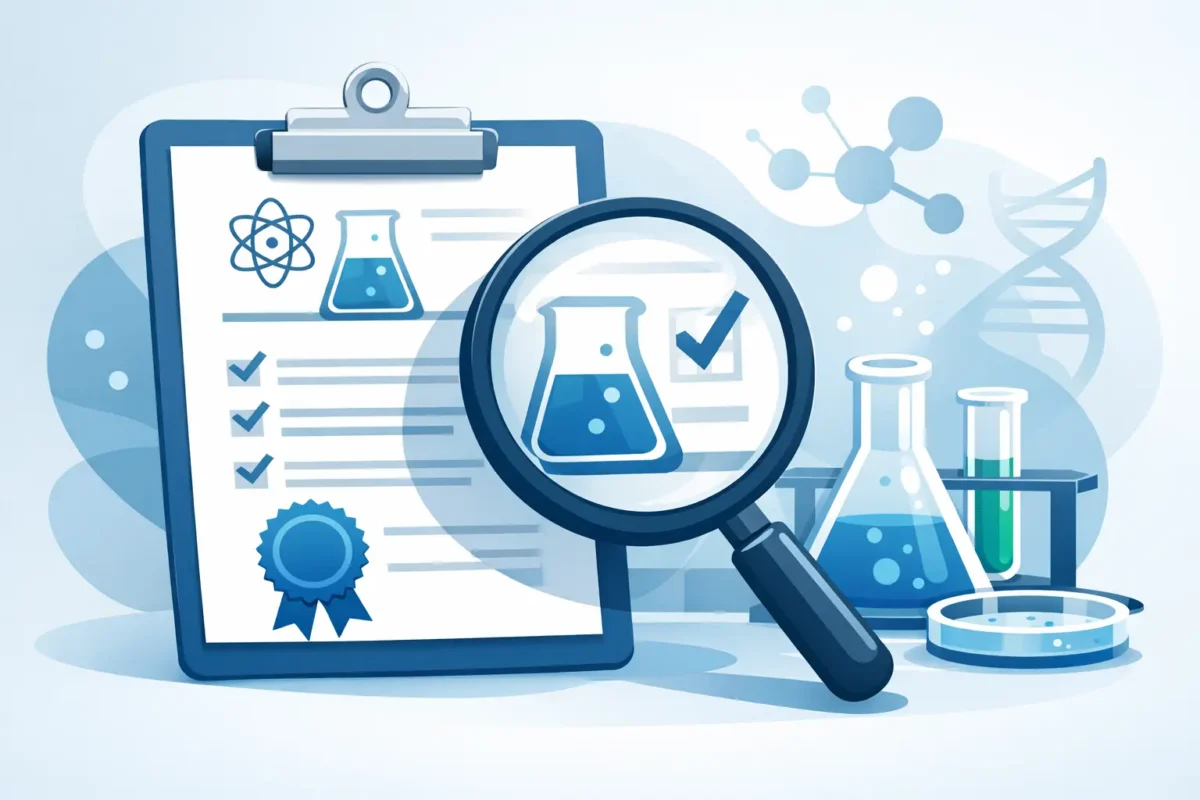
A certificate worth trusting usually contains the lab name, contact details, report date, sample ID, batch or lot reference, test method, result table, and some form of authorization such as a signature or analyst approval. Missing one item does not always mean fraud. Missing several should put you on alert.
The result table matters more than the marketing phrase above it. You want to see what was tested, the measured outcome, and ideally the units. A simple statement like “passed purity” is close to useless. Good reports show actual figures and often list target compounds, impurities, solvents, or contamination screening.
You should also look for whether the report is specific to identity, purity, and contamination, or whether it only covers one of those categories. Sellers often use “lab tested” as a blanket trust phrase when the report only confirms identity. That is not the same as showing overall purity or safety-related contamination screening.
Red flags that show a certificate may be fake or misleading
The most common red flag is a cropped image with no report number, no batch reference, and no way to connect it to a specific item. Another is a certificate that looks edited, blurred, or strangely inconsistent in font, spacing, or logo quality. That does not prove fraud by itself, but it deserves scrutiny.
Watch for results that look too neat. Exact round numbers, identical purity results across multiple batches, or reports that somehow show perfect outcomes every time can signal template reuse. Real lab data usually has variation. Even strong production runs do not tend to produce identical decimals forever.
Another warning sign is selective disclosure. A seller highlights purity but hides the full report. Or they show only the top section and leave out method details, contaminant results, and analyst information. When only the flattering part is visible, assume there is a reason.
If the report uses technical language incorrectly, that is another problem. Fake certificates often borrow scientific terms without using them in a way a lab actually would. Misnamed methods, impossible units, mismatched dates, and inconsistent compound names are all signs the document may have been assembled for appearance rather than accuracy.
Verify lab purity certificates by checking the lab itself
The lab name on the certificate should be more than decoration. Search whether it appears to be a real testing business with a traceable presence, stated services, and normal business details. If the lab cannot be found anywhere, that weakens the certificate immediately.
Even when the lab exists, the question becomes whether the report format fits that lab’s normal style. Some established labs use specific layouts, numbering systems, and terminology. A certificate that borrows the lab name but does not match its usual structure should be treated carefully.
This is also where context matters. Some labs are capable with certain classes of compounds but not all. A report from a real lab is still not ideal if it appears outside the lab’s typical scope or lacks the methods you would expect for that type of sample. Buyers who know the category should think beyond the logo and ask whether the testing makes technical sense.
Batch matching beats generic trust claims
A seller can say “lab tested,” “premium purity,” and “quality guaranteed” all day. Those are sales phrases, not verification. The strongest trust signal is a batch-specific certificate that matches the item in stock. If a seller updates inventory often, the documentation should update too.
This is one reason experienced buyers tend to value consistency over hype. A flashy storefront with broad claims is less useful than a seller who can show repeatable, batch-linked documentation and keep the details straight when asked. If you are comparing options, clarity usually tells you more than confidence does.
What purity percentages really tell you
A high purity number is not meaningless, but it has limits. Purity generally refers to how much of the target compound is present relative to other material in the sample. It does not automatically tell you what the remaining percentage contains. That leftover fraction could be minor and harmless, or it could include residual chemicals you would rather know about.
This is where buyers often oversimplify. Ninety-eight percent purity can be excellent in one context and less reassuring in another. It depends on the compound, the expected manufacturing process, the known risk profile of impurities, and whether contamination testing was done separately. A single number should never carry the entire trust decision.
You should also separate identity from potency and formulation. A certificate may verify that a compound is present, but not whether the final product is dosed consistently or packaged under good conditions. Especially with powders, solutions, and blended products, the path from lab sample to delivered item matters.
The smart way to use certificates before you buy
Treat lab reports as one part of due diligence, not the whole answer. A certificate is strongest when it is batch-specific, recent, complete, and consistent with the listing. It becomes much stronger when the seller is transparent, answers direct questions clearly, and does not dodge requests for matching details.
If the seller offers only generic claims, recycled screenshots, or partial documents, move carefully. In markets where buyers worry about scams, substitution, and adulteration, the difference between a real certificate and a decorative one is huge. Trust should come from verification, not from volume of promises.
The best approach is simple: read the report like it has to earn your confidence. If the batch matches, the methods make sense, the lab appears real, and the data is complete, you are looking at a stronger signal. If any of those pieces break down, keep your money moving in a different direction. A few extra minutes checking paperwork can save you from a bad order, and that is always worth it.
